

This is a challenge of the Justice4All art campaign of BiHao. This campaign asks the question: If unequal outcomes are evidence of injustice, why are some inequalities considered urgent while others remain invisible?
Justice4All explores the blind spots of contemporary justice movements by extending their principles into areas where they are rarely applied. The resulting campaigns range from plausible to absurd, forcing viewers to confront a central question: Are we committed to justice itself, or only to particular outcomes that favor groups with social and political influence?
By pursuing familiar moral principles beyond their usual boundaries, the project exposes the tension between universal ideals and selective advocacy.
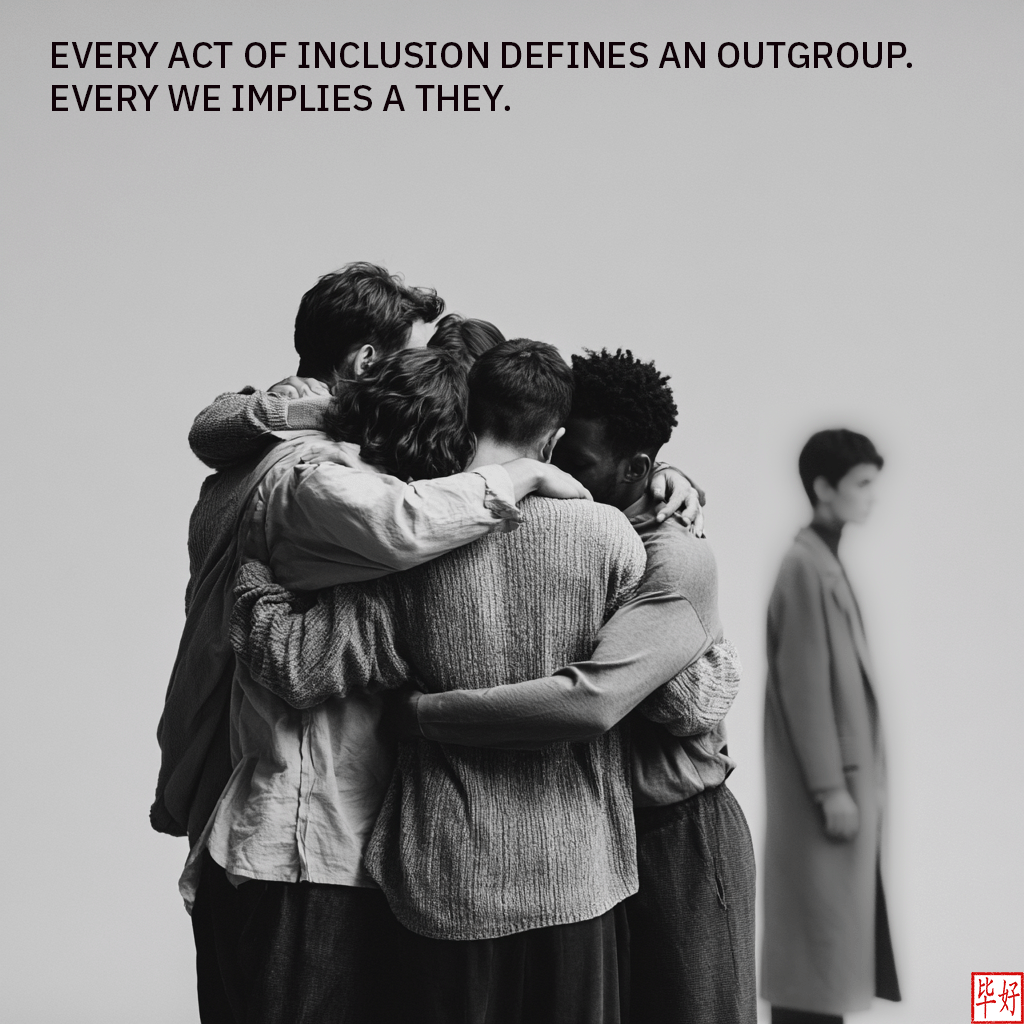
Challenge #1:
Inclusion is widely regarded as a moral good. We are encouraged to welcome, recognize, and include those who have been excluded.
But inclusion raises a paradox.
Every group has boundaries. Every community defines membership. Every we implies a they.
Inclusion expands a circle, but it also makes the circle visible. Once there is an inside, there is an outside.
Who belongs? Who does not? Who decides? And according to which principles?
This challenge invites viewers to reflect on a simple question:
If every act of inclusion defines an outgroup, what exactly makes inclusion good?
Interesting question! I’ve been viewing inclusion mostly as a practice, not as a state.
>how can we create spaces that remove barriers for disadvantaged groups?
How come inclusion is equaled with group membership in this train of thought?
Inclusive practices allow for more people who WANT to join, to join. No one else needs to decide for them, it just makes the group borders more permeable.
Circles (with in and out group) are part of life. By not looking we are in denial of how humans organise themselves. Isn’t it a moral act to create circles responsibly once awareness is there?